Track C · Ilua Light & Energy Programme

Solved together with the greenhouse, not after.
Production must function reliably under Arctic light and energy conditions. Many Greenlandic settlements depend on diesel for all electricity. If an Arctic greenhouse is to function as real local production infrastructure, light and energy must be solved together with the structure — not added afterwards.
The programme
Three integrated components.
C1, C2 and C3 are developed as one system — not as three add-ons. All three components integrate from the first design and field-measurement phase.
C1 · Light Concept
Passive light optimisation
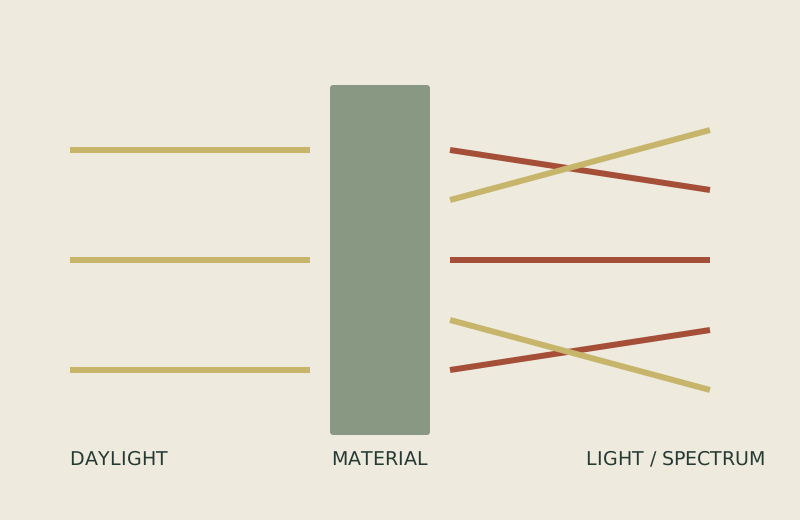
Cover materials, spectral control, light geometry and crop selection designed to maximise yield from the light actually available at 61°N. We maximise natural spectrum and geometry before considering active augmentation. This minimises winter power demand.
C2 · Energy Engineering
Energy supply partnership
Arctic-specialist partners provide power systems, controls and battery storage; we specify performance requirements; partners engineer the solution. Several candidates are in dialogue. Names and details announced on contract execution.
C3 · Storage Prototype 2027
Thermal mass and storage
Passive: the Ilua Sunyard berm wall acts as structural thermal mass, capturing daytime sun and re-radiating it on frost nights. Integrated: Arctic Ilua includes thermal energy storage (e.g. a sand battery), designed in from the first sketch rather than added afterwards.
Status & integration
A coordinated layer across the greenhouse and the microclimate.
Light & Energy is system integration: it combines established research on passive solar gain, thermal mass and thermal energy storage (TES) with newer work on Arctic and sub-Arctic energy supply.
It develops thermal energy storage, light geometry, spectrum choices and energy supply across the greenhouse (Track A) and the microclimate (Track B) — not as a separate add-on. Each component matures alongside the structure it supports, so the systems behave as one in operation.
Field measurements from the first prototype (Phase 2, 2027) will validate the integration choices and feed into the open-source publication.
The long-term goal
Year-round production powered by renewable energy.
The prototype starts with minimal winter operation and scales gradually. The long-term goal is year-round production powered by renewable energy. We measure, share data openly, and field measurement drives design refinement.
Phase 1 is underway
Support the next round of development.
Public support keeps measurements, engineering preparation and specialist coordination moving.